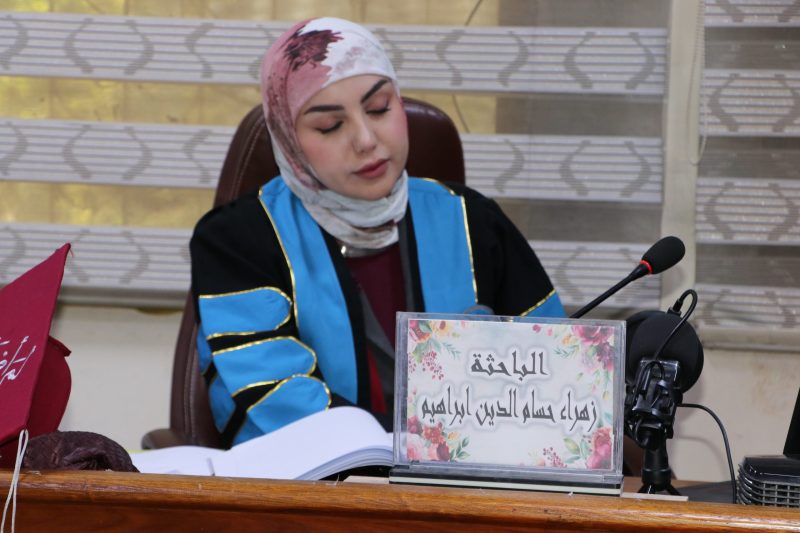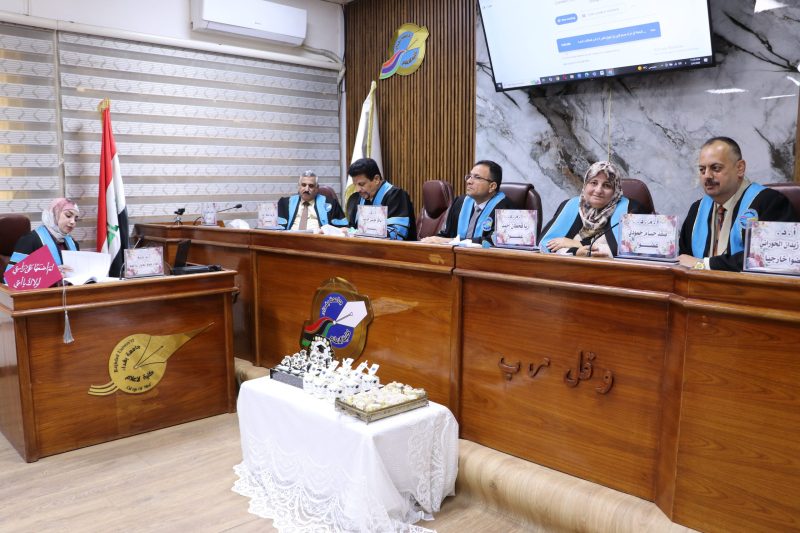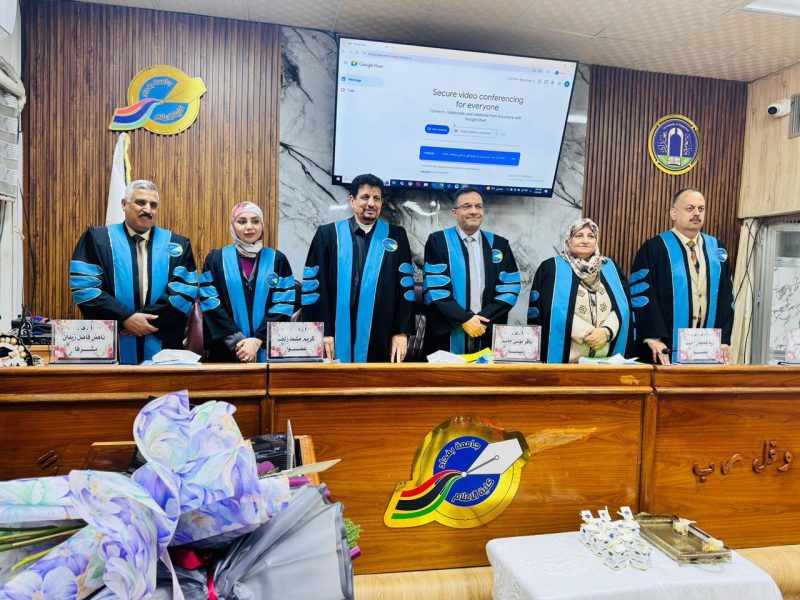
A doctoral thesis titled “The Role of Public Relations in Shaping Public Attitudes Toward Women’s Empowerment in Governmental Institutions: An Analytical Study of the Websites of the Ministries of Health and Higher Education and a Field Study of the Female Public” was discussed at the College of Mass Communication, University of Baghdad. The research was conducted by Zahraa Hossam Al-Din Ibrahim, a student in the Department of Public Relations.
The defense committee included Professor Dr. Baqir Mousa as Chair, Professor Dr. Nahid Fadel as Supervisor, Assistant Professor Dr. Ria Qahtan Ahmed, Assistant Professor Dr. Karim Masht, and Assistant Professor Dr. Safad Hossam Al-Shammari as members, along with Professor Dr. Nahla Zaidan as an external member.
The thesis presented an analytical study of the websites of the Ministries of Health and Higher Education, alongside a field study of female audiences, aiming to uncover the role of public relations activities in promoting a culture of women’s empowerment and enhancing their presence in governmental institutions.
The study employed a descriptive-analytical methodology, including content analysis of the two ministry websites, a survey distributed to a sample of 400 respondents, and interviews with officials from government media and communication departments. The goal was to examine the nature of PR activities and programs that support women’s image and participation in the workplace and leadership positions.
Results indicated that public relations significantly contributed to raising women’s knowledge and awareness regarding empowerment, particularly in areas such as self-confidence, rights, and social participation. Interactive PR activities, such as workshops and training programs, were found to be more effective in shaping positive attitudes compared to non-interactive methods.
The study also revealed a strong positive statistical correlation between PR activities and the level of public awareness on women’s empowerment, highlighting the vital role of institutional communication. Additionally, women relied heavily on digital media and social media platforms for information related to empowerment.
The thesis recommended adopting long-term PR strategies that place women’s empowerment at the core of institutional communication policies, increasing interactive activities like workshops and training sessions, linking empowerment discourse to practical measures such as career advancement, equal pay, and expanded leadership participation, utilizing digital and social media platforms effectively, and enhancing collaboration between governmental institutions and organizations concerned with women’s rights to maximize the impact of communication efforts.