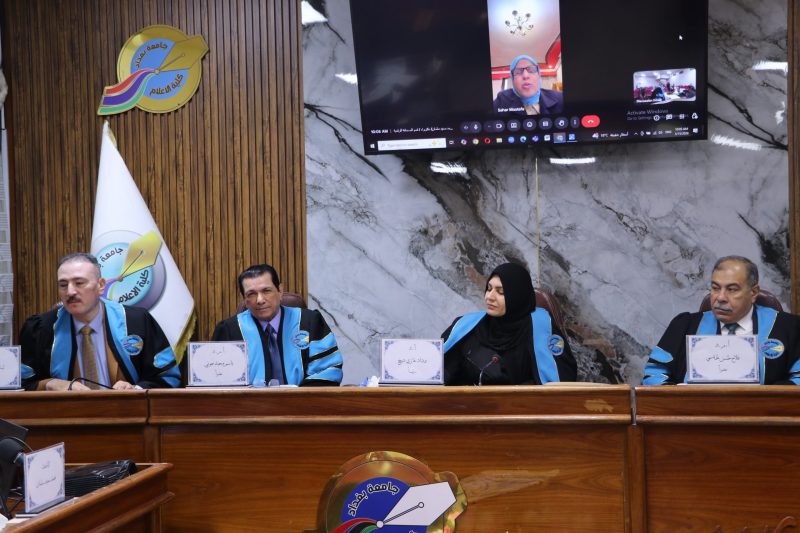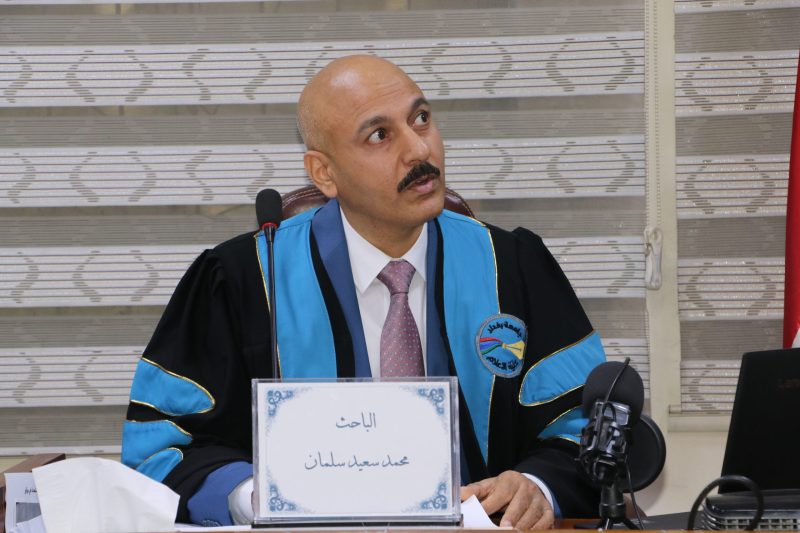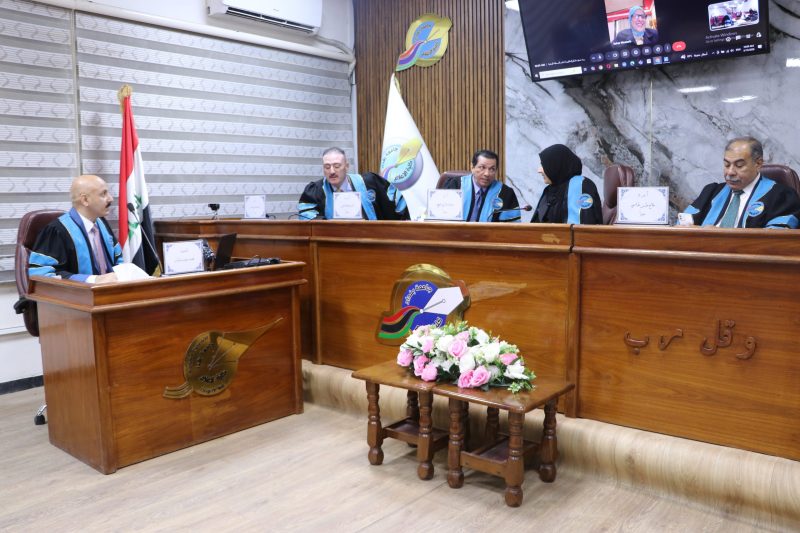
The College of Mass Communication at the University of Baghdad organized a discussion of the doctoral thesis entitled “The Competencies of Arab Journalists in Utilizing Digital Technology and Their Impact on News Website Output: A Survey Study,” presented by the researcher Mohammed Saeed Salman from the Department of Digital Journalism.
The examination committee was chaired by Professor Dr. Widdad Ghazi Dabakh, with Professor Dr. Laith Badr serving as supervisor. Committee members included Associate Professors Dr. Basem Wahid Joni, Dr. Bairq Hussein, and Dr. Falah Hassan, while Professor Dr. Sahar Mustafa served as an external member.
The thesis aimed to examine the extent to which Arab journalists employ digital technologies in news content production, identify the most prominent digital skills possessed by journalists working at news websites, and examine the types of digital technologies employed in journalistic practice.
The study adopted a descriptive survey methodology, including a sample of journalists from several Arab news websites, alongside an analysis of journalistic content on three specific sites: the Iraqi website (964), the UAE-based Al-Ain News website, and the Al-Araby Al-Jadeed website.
The study reached several conclusions, most notably that Arab journalists have partially transitioned to the practical application of digital technologies and rely on them to carry out their daily tasks, with their use primarily focused on core technologies related to recording, filming, and editing. However, the adoption of advanced digital technologies in news content production remains limited.
The findings also indicated that Arab journalists possess a good level of basic digital skills, but demonstrate relative weakness in advanced digital skills, such as big data analysis and information extraction. Furthermore, many rely on self-directed learning to develop their digital competencies.
The thesis presented a set of recommendations emphasizing the importance of developing media and training policies in Arab journalistic institutions, promoting investment in modern digital technologies, and updating media college curricula to keep pace with the rapid transformations in the digital media environment.
This study contributes to ongoing scientific efforts aimed at enhancing the professional performance of Arab journalism and strengthening its capacity to adapt to the digital transformation in media content production.