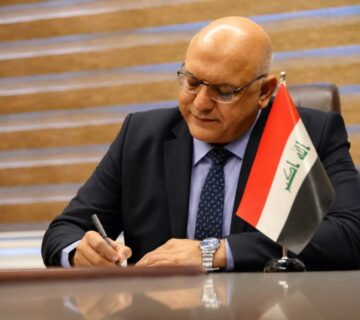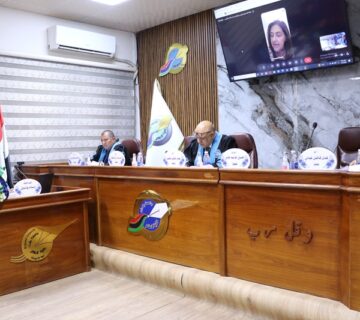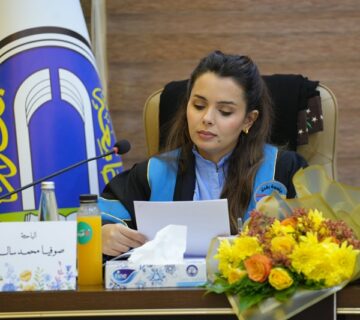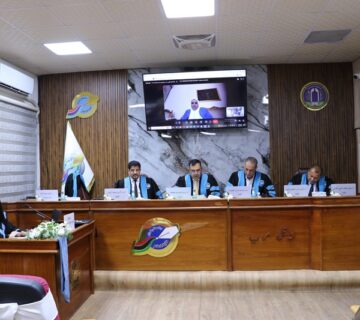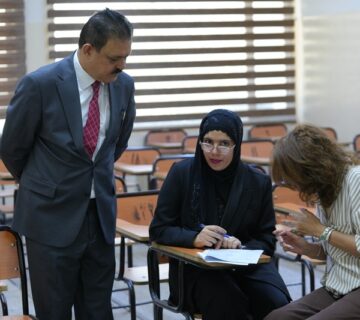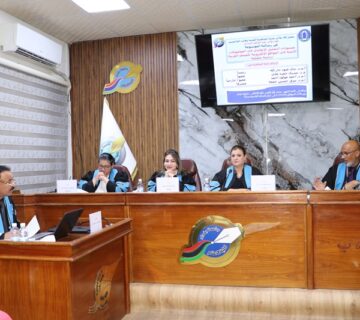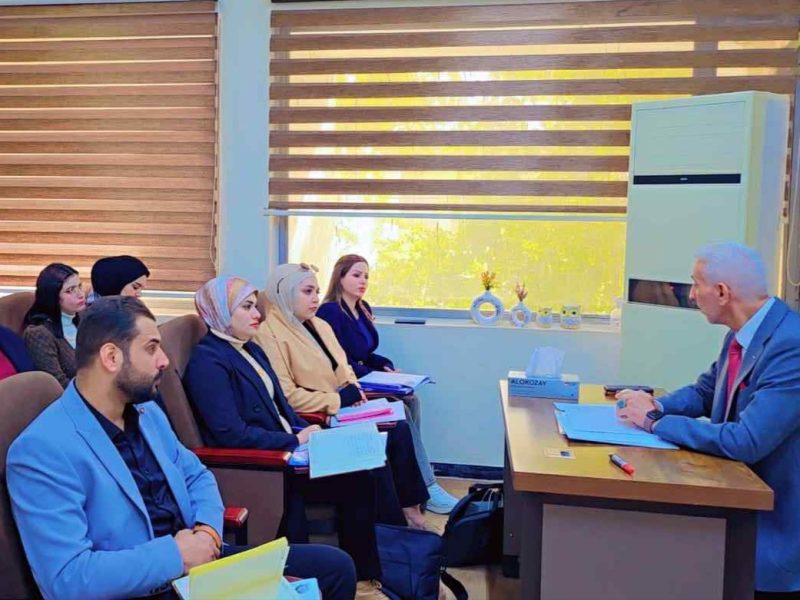
The Arabic Language Safety Unit at the College of Mass Communication, University of Baghdad, organized a scientific seminar entitled “Speech Act Theory and Discourse Analysis in Radio and Television Studies”. The seminar was presented by Professor Hussein Ali Noor and moderated by Assistant Professor Dr. Nebras Hussein Al-Azzawi, with the attendance of a distinguished group of faculty members as well as postgraduate and undergraduate students.
Professor Hussein Ali Noor reviewed the theoretical foundations of Speech Act Theory, highlighting it as one of the most prominent contemporary linguistic-communicative theories. He explained that “language in media discourse is not only used to convey information but also to perform speech acts with specific intentions and direct effects on the audience, such as commands, promises, threats, announcements, and justifications.”
The lecturer discussed the origins of the theory with the British philosopher John Austin, who proposed its threefold division: locutionary acts, illocutionary acts, and perlocutionary acts. He emphasized that each media statement encompasses all three levels simultaneously. He also presented the development of the theory by John Searle, who classified illocutionary acts into five main types: assertives, directives, commissives, expressives, and declarations.
Dr. Noor demonstrated how to apply the theory in practice to analyze television discourse by asking three methodological questions: What was said? What is intended? What is the expected impact on the audience? He explained that analyzing statements, news bulletins, and talk shows reveals the implicit intentions behind linguistic formulations and enables researchers to distinguish between what is explicitly stated and what is implicitly conveyed.
He also provided practical examples from television discourse, showing how simple news phrases can perform illocutionary functions such as justification, threat, or reassurance, producing perlocutionary effects ranging from calming the audience to causing concern or mobilizing public opinion.
The seminar emphasized the importance of adopting Speech Act Theory as a methodological tool in radio and television studies, as it provides a scientific framework for understanding the linguistic structure of media discourse and its communicative, social, and political dimensions.
The seminar witnessed notable scholarly interaction from attendees through interventions and questions, reflecting a growing interest in enhancing linguistic studies in the media field, which contributes to advancing academic analysis and fostering professional critical awareness among media students.