

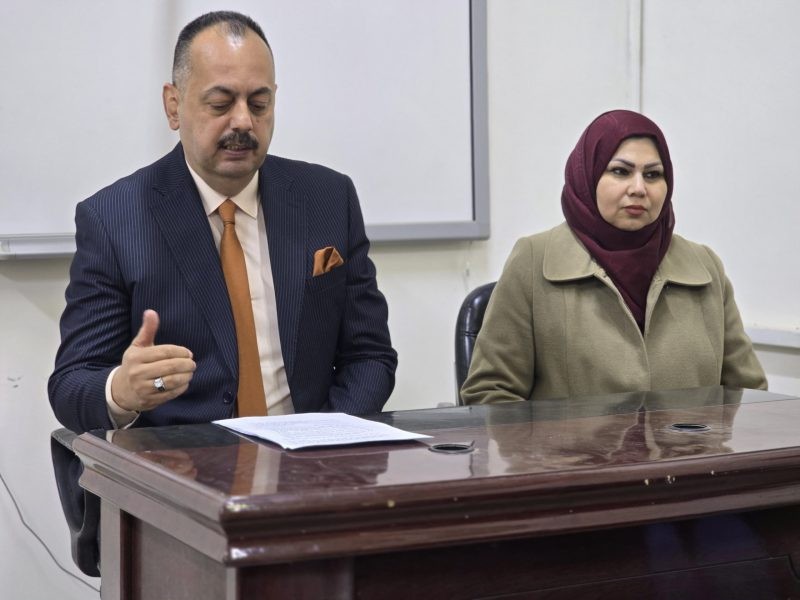
The College of Mass Communication at the University of Baghdad, through the Arabic Language Integrity Unit, organized a workshop on employing artificial intelligence (AI) tools in reviewing media texts. The session was presented by Assistant Professor Dr. Safed Hussam Hammoudi, a faculty member in the Department of Radio and Television, and managed by Assistant Professor Dr. Nebras Al-Azzawi, Head of the Unit.
The workshop focused on the mechanisms of integrating AI tools in media text review, using AI programs and models as intelligent assistants during the editing process. These tools help analyze and enhance texts before publication from multiple perspectives—linguistic, media-related, and ethical—while the human editor retains the final decision. Effective use of AI in this context requires well-prepared databases relevant to the media environment and a clear identification of the media institution’s identity.
The session highlighted the importance of integrating AI in newsroom tasks, particularly in automating processes that were previously manual, such as:
- Automated linguistic proofreading: correcting spelling, grammar, punctuation, sentence structure, and enhancing style.
- Improving headlines and content clarity: simplifying sentences, removing redundancy, and increasing impact.
- Media quality review: ensuring text suitability as news, clarity of message, paragraph coherence, and detecting bias or contradictions.
- Harmful content detection: identifying hate speech, incitement, sensitive or inaccurate information.
- Sentiment and audience impact analysis: assessing the tone (positive, negative, neutral) and its potential effect on the audience.
- Professional rewriting suggestions: proposing alternatives to improve clarity, professionalism, or audience engagement, while maintaining internal consistency.
The workshop also demonstrated practical steps for reviewing media texts using AI, including entering raw text into the AI tool, running linguistic and stylistic checks, analyzing headlines, suggesting improvements, detecting bias and misinformation, evaluating audience impact, verifying paragraph coherence, and producing a final version ready for publication.
Dr. Hammoudi presented examples of AI commands for media text review, such as:
- Linguistic proofreading: “Correct the following text linguistically and grammatically while preserving the meaning.”
- Style improvement: “Enhance the phrasing to be more impactful and engaging for the Iraqi media audience, while simplifying long sentences.”
- Media verification: “Does this text meet journalistic standards for news writing? Suggest improvements if needed.”
- Bias detection: “Analyze the text for media bias or non-neutral language and highlight any examples found.”
The workshop emphasized that AI tools, when used effectively, complement human editorial judgment, enhance media quality, and support professional development in modern media practices.


