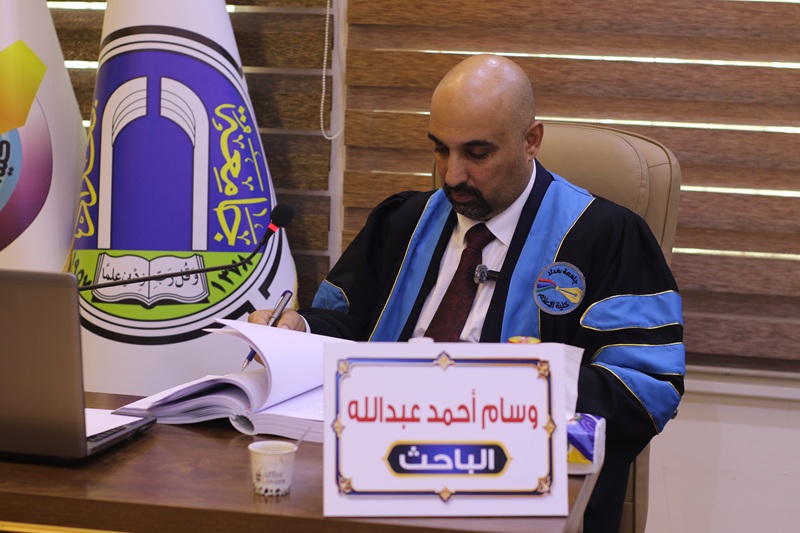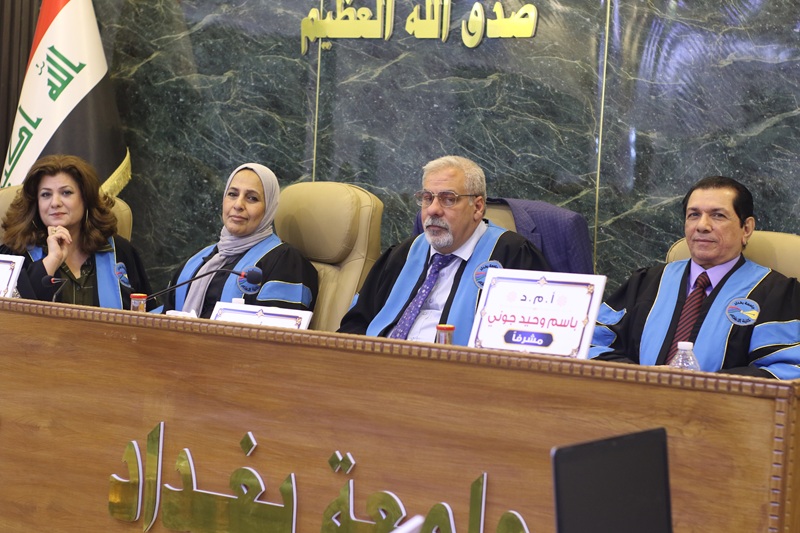
A doctoral dissertation titled “U.S. Propaganda Techniques on News Websites and Their Impact on Iraqis’ Perceptions of the United States: A Survey Study,” by Wissam Ahmed Abdullah, a researcher in the Department of Digital Journalism, was discussed at the College of Mass Communication, University of Baghdad.
The discussion committee was chaired by Professor Dr. Bushra Jameel, with Assistant Professor Dr. Basim Waheed serving as supervisor. The committee included Professor Dr. Noah Ezz Al-Din, Assistant Professor Dr. Nada Abboud, and Assistant Professor Dr. Rawaa Hadi, as well as Professor Dr. Abdul Salam Ahmed as an external member.
The dissertation examined the use of propaganda as a tool of foreign policy employed by major powers, focusing on the nature of propaganda techniques used by U.S. news websites and their impact on shaping Iraqis’ perceptions of the United States, particularly through CNN Arabic and Alhurra.
For the analytical component, the researcher used a census approach to analyze news stories, articles, reports, and news features published on the two websites from March 1 through August 31, 2025. A total of 1,710 journalistic materials were analyzed. The findings showed that the two websites employed 18 propaganda techniques falling under 88 subcategories.
For the field component, the study adopted a descriptive-analytical approach, using a questionnaire to collect and analyze data from a sample of 400 Iraqi respondents from the fields of media, political science, psychology, and sociology. The questionnaire was administered from February 20 through December 20, 2025.
The study revealed mixed effects of exposure to U.S. propaganda through the two websites. The media content contributed to shaping a positive image of the United States by portraying it as a reliable military, economic, and scientific power, while generating negative perceptions on certain issues, particularly those related to the Arab-Israeli conflict and U.S. positions toward Iran, Lebanon, and Iraq, as well as its media discourse toward China.
The findings indicated that the propaganda techniques employed were not limited to direct influence on audiences, but relied on a combination of cognitive, psychological, and emotional persuasion to shape attitudes toward issues and events. This reflected an integrated media strategy aimed at constructing a particular image of the United States and its policies.
The dissertation also concluded that the current propaganda strategy does not necessarily rely on “total brainwashing” or a radical transformation of ideological orientations. Rather, it seeks to achieve a conscious and profound objective: fostering acceptance and understanding of U.S. justifications and motivations among audiences, while also influencing how political events are interpreted.
The study emphasized the importance of developing critical media awareness among Iraqi audiences regarding foreign media content, particularly amid the growing role of international news platforms and websites in shaping attitudes and perceptions of political issues.
The dissertation recommended conducting broader field studies on the impact of following U.S. news websites on the development of a national media perspective toward major regional issues. It also proposed organizing specialized academic workshops and training courses on the influence of propaganda techniques during times of crisis and their effects on audiences. In addition, it recommended establishing an academic research center at the University of Baghdad dedicated to propaganda analysis and digital diplomacy, with the aim of contributing to the enhancement of Iraqi national security.
The study reflects the College of Mass Communication, University of Baghdad’s commitment to advancing research on international media and its influence on public opinion, thereby contributing to the development of media and critical awareness in society. It also aligns with Sustainable Development Goal 4: Quality Education, particularly in promoting knowledge, critical-thinking skills, and information literacy.