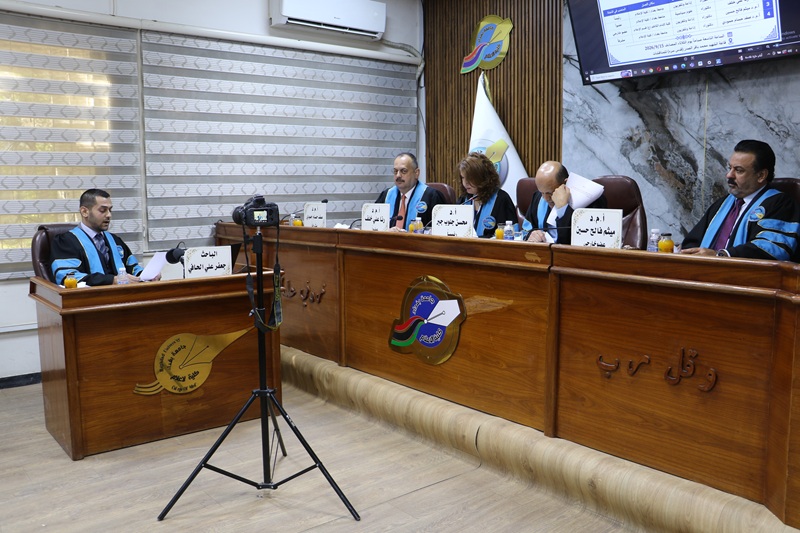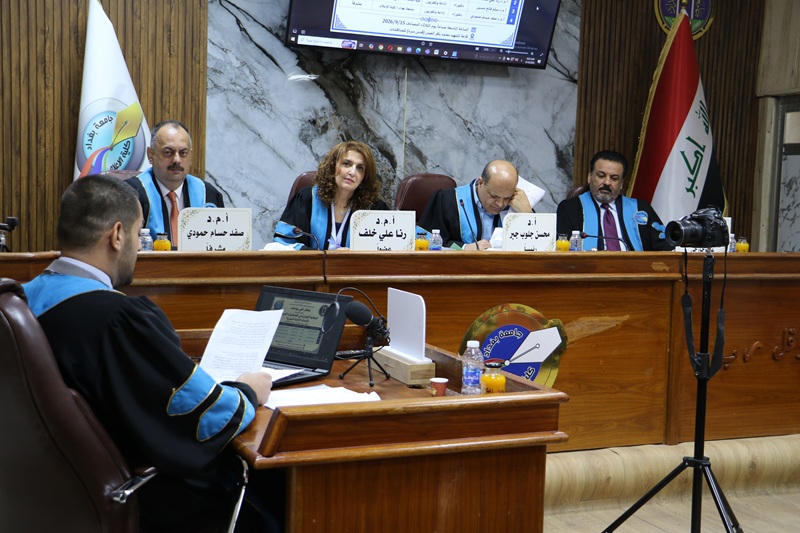
A master’s thesis titled “News Coverage of Syrian Security Events on Arab Satellite Channels” was discussed at the College of Mass Communication, University of Baghdad by Jaafar Ali Yousif, a researcher in the Department of Radio and Television.
The discussion committee was chaired by Professor Mohsen Jaloub Jabr, with Assistant Professor Safad Hussam serving as supervisor. The committee included Assistant Professor Rana Ali Khalaf and Assistant Professor Maytham Falih as an external member.
The study aimed to examine the nature of news coverage of Syrian security events on Arab satellite channels and analyze the framing and editorial approaches used to cover developments on the ground and in the political sphere. It also sought to identify the extent of change or continuity in the editorial policies of the channels under study.
The thesis adopted a descriptive methodology using both quantitative and qualitative content analysis. It employed a systematic probability sample designed according to the constructed-week method, covering 84 news bulletins, divided equally between the two channels: 42 episodes of Al Jazeera’s “Al Hasad” and 42 episodes of Al Mayadeen’s “Evening News,” during the period from March 1 to August 31, 2025.
The findings showed differences in the two channels’ approaches to news narration and coverage. Al Jazeera tended to recategorize field actors and incorporate them under the category of “government forces,” accounting for 31.50%, while placing greater geographic emphasis on major urban centers at 47.62%. Al Mayadeen, by contrast, placed greater emphasis on armed actors operating outside centralized control, with a stronger focus on rural areas and mountainous villages, accounting for 53.73%.
The findings also revealed that the conflict frame was the dominant approach to coverage on both channels, although significant differences emerged in framing and narrative styles. Al Jazeera combined analytical and explanatory approaches, which together exceeded 52%, while Al Mayadeen relied heavily on conventional news reporting, accounting for 60.33%, alongside the use of an adversarial approach at 14.88%. These differences reflect contrasting approaches to constructing the news narrative surrounding Syrian security events.
The study concluded that news coverage of Syrian security events was not uniform across the two channels. Instead, the channels differed in their selection of actors, geographic locations, conflict frames, and narrative and reporting approaches, reflecting differences in how each channel constructed its news portrayal of the events in accordance with its editorial policies.